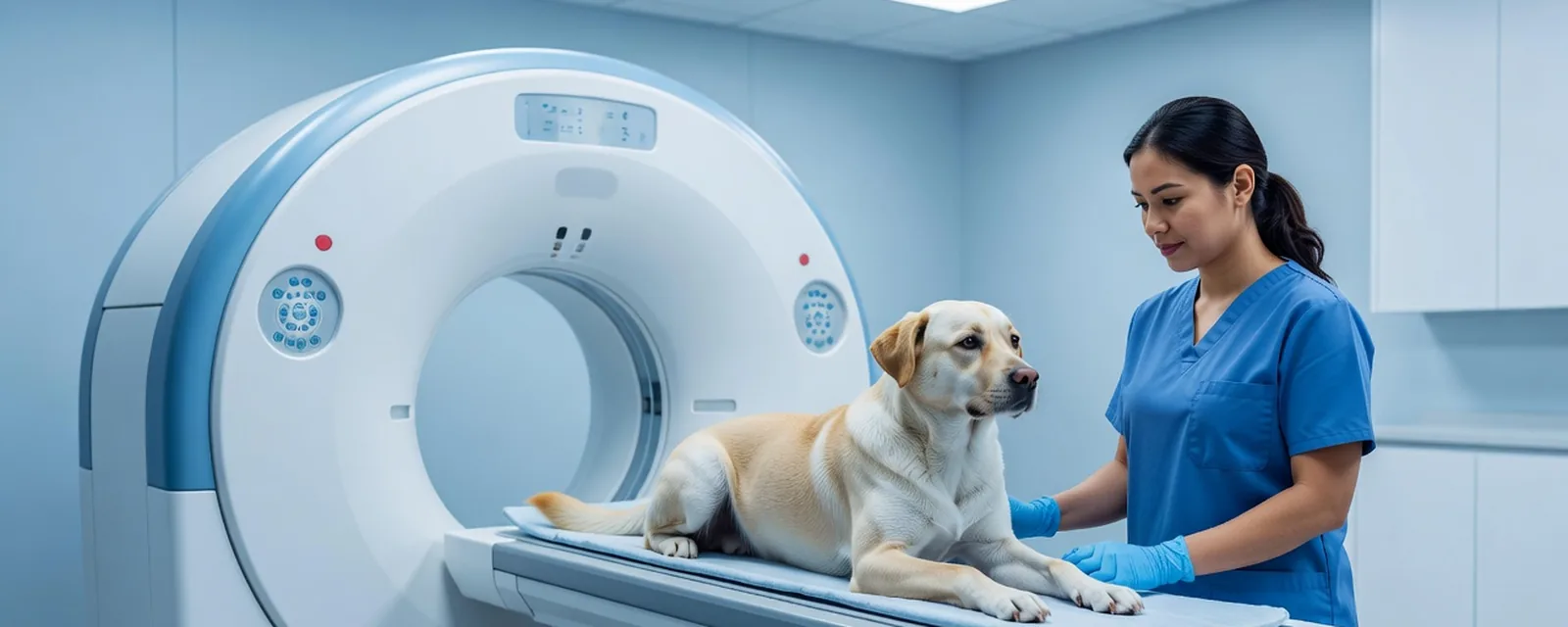
A CT (computed tomography) scan takes hundreds of X-ray slices in seconds and assembles them into a detailed three-dimensional view of your pet's body — bone, soft tissue, chest, and skull in a level of detail flat X-rays simply can't match.
Very few general practices have CT on-site. Ours does — which means the scan that would otherwise mean a referral appointment across town and a separate anesthetic event happens here at our Glendale hospital, often the same day the question comes up, with board-certified radiologist consultation on complex studies.
What our CT service covers
- Nasal disease and chronic sneezing workups
- Middle and inner ear disease
- Complex and subtle fractures, elbow and joint disease
- Tumor staging and surgical planning
- Chest scans for lung disease and metastasis checks
- Head, skull, and dental-related imaging
What to expect
Most CT patients drop off in the morning, receive brief sedation or light anesthesia with full monitoring, and are scanned in minutes. Urgent findings are reviewed immediately, complex studies go to a board-certified radiologist, and we call you with results and a clear plan — usually the same day.
Veterinary CT Scans guides & handouts
Take-home guides from our resource library related to this service.
CT Scans for Dogs and Cats: What They Show and When Your Pet Needs One
Standard X-rays flatten a three-dimensional body into one image — organs and bones stack on top of each other, and subtle problems hide in the overlap. A CT scanner instead captures cross-sectional slices, like examining one page of a book at a time instead of trying to read the whole book through its cover.
The result: fractures too subtle for X-ray, tumors mapped to the millimeter, sinus and ear canals seen clearly for the first time — information that changes diagnoses and surgical plans.
When We Recommend a CT Scan
- Chronic nasal discharge, sneezing, or nosebleeds — CT is the gold standard for nasal disease
- Recurrent ear infections that don't resolve — to check the middle ear and bulla
- Complex fractures of the pelvis, joints, or skull before surgical repair
- Elbow dysplasia and lameness cases X-rays can't fully explain
- Measuring a tumor's true extent and checking lymph nodes before removal
- Screening lungs for metastasis with far more sensitivity than X-rays
- Head trauma and dental disease extending into the jaw
How a CT Scan Works — and What Your Pet Experiences
The scan itself is fast — often under a minute of actual scanning. Pets need to hold perfectly still, so most receive brief sedation or light general anesthesia, with the same pre-anesthetic screening and monitoring we apply to any procedure. Some studies include IV contrast dye, which highlights blood vessels and makes tumors and inflammation stand out.
Most patients are in and out the same day, awake and home for dinner.
CT vs. X-ray vs. Ultrasound vs. MRI
- X-rays: fast, inexpensive, excellent first look at bones and chest — limited by overlapping structures
- Ultrasound: real-time views of soft abdominal organs and the heart — poor at bone and air-filled areas
- CT: fast 3D imaging that excels at bone, lungs, the nose, the skull, and surgical planning
- MRI: superior for brain and spinal cord detail, but slower and referral-only
These tools complement each other, and we'll always tell you plainly which one actually answers the question — including when the answer is a cheaper X-ray, or a referral MRI we don't perform.
What Happens After the Scan
Images are reviewed immediately for urgent findings, and complex studies are sent for board-certified radiologist interpretation. You get a clear explanation of what was found and what it means — whether that's a surgical plan, a treatment protocol, or genuine reassurance that nothing serious is hiding.
Why Choose Angelus Pet Hospital for CT Imaging
- CT scanning on-site in Glendale — rare for a general practice
- Same-day scans when a diagnosis shouldn't wait
- One anesthetic event when CT is combined with surgery or dentistry
- Radiologist consultation on complex studies
- Results explained in plain language, with next steps you can act on
Frequently asked questions
How much does a pet CT scan cost?
Having CT in-house at Angelus Pet Hospital typically makes it more affordable — and much faster — than a specialty-center referral, since exam, scan, and treatment planning happen in one place. We'll quote the cost for your pet's specific study, including sedation and radiologist review, before scheduling.
Is the radiation from a CT scan safe for my pet?
Yes. A CT scan uses more radiation than a single X-ray but still a low, carefully controlled diagnostic dose — and it's typically a once-or-rarely event, not a repeated exposure. The diagnostic benefit overwhelmingly outweighs the risk when a scan is medically indicated.
Why does my pet need anesthesia for a painless scan?
Only because the scan requires perfect stillness — even gentle breathing motion blurs fine detail. Most pets need just brief sedation rather than full anesthesia, wake quickly, and go home the same day.
Ready to schedule?
Request an appointment at our Glendale clinic or call our team — we serve pets and their people across the surrounding communities.
Need help with the cost? Explore financing options