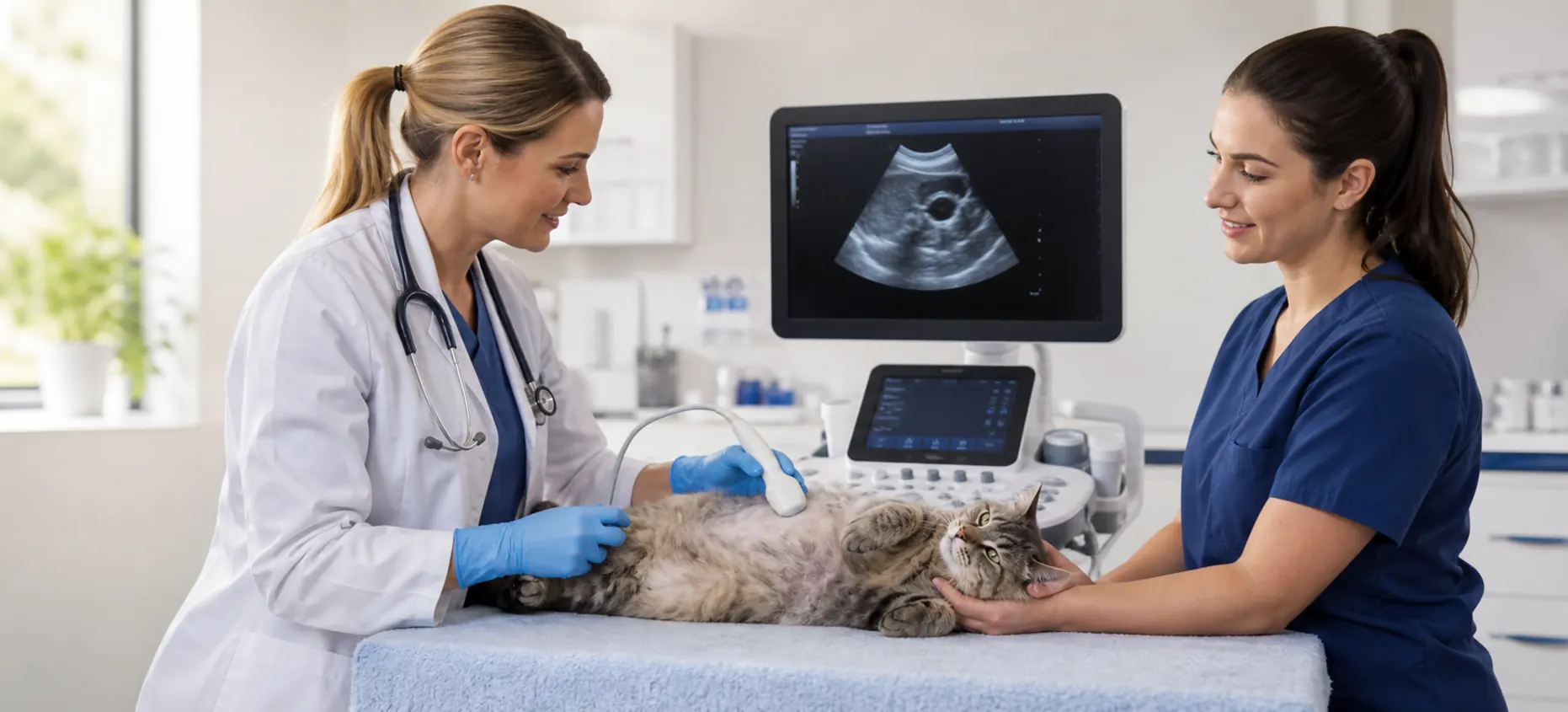
When a cat is vomiting, limping, straining to urinate, or simply 'not right,' imaging often provides the answer. Digital radiographs reveal bones, bladder stones, heart size, and lung patterns in minutes, while ultrasound lets us examine the texture and structure of organs in real time.
For complex cases, CT (computed tomography) scanning adds detailed cross-sectional views of bone, soft tissue, the chest, and the skull — especially valuable for nasal disease, subtle fractures, and surgical planning.
Most imaging is performed while you wait, with gentle positioning and sedation only when needed for your cat's comfort. Results are interpreted promptly, and complex studies can be reviewed by board-certified radiologists.
Imaging capabilities
- Digital X-rays of chest, abdomen, and bones
- Abdominal ultrasound
- CT (computed tomography) scans
- Bladder and urinary tract evaluation
- Pre-surgical and cardiac screening
- Radiologist review for complex cases
What to expect
Most imaging happens during your visit: gentle positioning for digital X-rays takes minutes, and ultrasound is done with a warm gel and patience rather than restraint. Sedation is used only when it genuinely lowers your cat's stress. We review findings with you the same visit and send complex studies for radiologist review.
Ultrasound
- Non-invasive, real-time imaging of the abdomen and heart
- No anesthesia needed for most patients
- Helps evaluate organs X-rays can't fully show
- Results reviewed with you the same visit whenever possible
Imaging guides
Cat Diagnostic Imaging guides & handouts
Take-home guides from our resource library related to this service.
Frequently asked questions
When does a cat need an X-ray versus an ultrasound?
X-rays excel at bones, chest, and anything with clear density differences — fractures, bladder stones, heart size, swallowed objects. Ultrasound sees inside organs: texture, masses, fluid, and movement. Vomiting and urinary cases often benefit from both, each answering different questions.
Is the radiation from X-rays dangerous for my cat?
Modern digital radiography uses very low doses, and the handful of images in a typical study carries negligible risk — far less than the risk of missing a diagnosis. Ultrasound uses no radiation at all.
Will my cat need to be sedated for imaging?
Usually not. Most cats tolerate brief, gentle positioning, especially in a quiet room with unhurried handling. We reserve light sedation for painful positioning or very anxious cats — and for them it makes the experience kinder, not riskier.
What Is Veterinary Diagnostic Imaging For Felines?
Veterinary diagnostic imaging includes radiographs (x-rays), ultrasound, and CT scans, all of which are used as diagnostic tools to collect information on your cat's health. The vast majority of imaging is non-invasive and completely painless. However, some imaging may require sedation or even anesthesia because the cat must be kept still to allow for adequate images to be produced. Veterinarians use these images to collect information on your cat to help them to make a medical and sometimes surgical plan.
Cat X-Ray Images
Cat x-ray images have been in use throughout the medical community for many decades. Cat x-ray images are by far the most regularly used form of diagnostic imaging in the veterinary industry because they are cost effective (comparatively speaking), and they can accurately diagnose the state of skeletal structure and composition, large body cavities, and the presence of many foreign objects. Cat x-ray images are totally painless, but some cats can benefit from sedation to reduce anxiety and stress. Cat x-ray images usually proceed as follows: The cat is placed on the x-ray table A technician positions the x-ray machine so that the x-ray beam targets only the area of interest Modern x-ray equipment allows for low levels of radiation and when used only occasionally are perfectly safe for your cat. Because cat x-rays are static images, the procedure usually requires less time than a procedure like an MRI Cat x-ray images traditionally used to be captured on actual film. However, our x-ray images are now digital which allows us to capture the images on a secure server that our veterinarians can access at any time, and can also share with specialists, if necessary.
Cat Ultrasounds
A cat ultrasound is the second most common type of diagnostic imaging tool veterinarians use to diagnose a cat's medical condition. Ultrasounds use sound waves to examine and photograph internal tissues in real time. An ultrasound allows a veterinarian to see into a cat's body in real time, allowing for easy viewing of organs from different angles and with more detail that is not easily achieved through x-ray images. The functioning of various organs can be observed to determine if they are malfunctioning. A cat ultrasound procedure usually proceeds as follows: A doctor gently presses a small probe against the cat's body that emits digital sound waves. The sound waves are directed to various parts of the cat's abdominal area by manually shifting the probe's position. The sound beam changes velocity while passing through varying body tissue density, which causes echoes. Our ultrasound equipment converts these echoes into electrical impulses that are then further transformed into a digital image that represents the appearance of the tissues These images can be viewed in real time by a veterinarian, as well as stored for further review at any time Common symptoms that may cause a veterinarian to use ultrasound include: vomiting, weight loss, kidney disease, intestinal blockage, and heart disease.
Cat MRI
_\*Please note that MRIs are NOT performed at Angelus Pet Hospital. If your veterinarian feels an MRI is needed, we will refer you to a specialty hospital for treatment._ Magnetic resonance imaging, or MRI, is the newest form of diagnostic imaging being used for both human and veterinary medicine. Cat MRI equipment generates a very powerful magnetic field, resulting in detailed anatomic images of whatever part of a cat's body is being scanned. No x-rays are involved, and a cat MRI is considered extremely safe. A cat MRI procedure usually proceeds as follows: Cats must be anesthetized for this procedure because they cannot be restrained by humans and must remain still during the procedure. For the procedure, a cat is placed in a tubular electromagnetic chamber. The cat's body is continuously pulsed with radio waves for a period of time, usually 10-20 minutes. The pulsing causes the cat's body tissues to emit radio frequency waves that can be detected by the MRI equipment. Many repetitions of these pulses and subsequent emissions are required in order to generate adequate digital feedback for the equipment to interpret The feedback is then converted into images that can be displayed on a screen, and can also be saved for future study A cat MRI is not used as regularly as an x-ray or ultrasound because the equipment is very expensive, very large, and requires specially trained technicians to operate. However, if after an X-ray and Ultrasound your veterinarian feels an MRI is the next step in diagnosing your cat's illness, we will refer you to a specialty hospital for treatment.
CT Scans For cats
_\*Please note that CT scans are NOT performed at Angelus Pet Hospital. If your veterinarian feels a CT scan is needed, we will refer you to a specialty hospital for treatment._ CT scans for cats, also known as 'cat scans', are computer enhanced cat x-ray procedures most often used to evaluate complex parts of the body, such as the head, chest, some joints and various internal organs. CT scans show different levels of tissue density, and produce more detailed images than x-ray images. Unlike MRIs, CT scans for cats do not use magnetic field waves so they cannot compare changes in fluid levels due to inflammation or bleeding. Therefore, CT scans for cats are used in situations where an MRI is considered unnecessary but traditional x-ray images are inconclusive or insufficient. CT scans for cats usually proceed as follows: Cats must be anesthetized for this procedure because they cannot be restrained by humans and must remain still during the procedure. The cat is placed on a motorized bed inside of a CT scanner, a machine that takes a series of x-rays from various angles\* When one series, or scan, is completed, the bed moves forward, and another scan is taken A computer uses these scans to create cross-sectional images of the body part under investigation, and then displays the images on a monitor (A contrast dye may be injected intravenously to make it easier to see abnormalities) By sequentially scanning an entire body area, an organ or other structure can be imaged without invasively penetrating the body, or disrupting neighboring structures CT scans for cats are most often used by our veterinarians to detect structural changes deep within a cat's body, including: Tumors Deep abscesses or foreign body presence Ligament tears How Feline Radiographs Influence Veterinary Recommendations The goal of feline radiographs is to ascertain a diagnosis, or obtain a final answer without having to perform further, more invasive tests or procedures. For example, an x-ray might show evidence of a tumor of the spine and possibly involve the surrounding muscle. The addition of an MRI would reveal the specific tumor location and the extent that the tumor extends into the surrounding muscle tissue. This type of information is very important for a prognosis and treatment plan. Veterinary diagnostic imaging offers an array of incredibly useful tools within a veterinarian's toolkit. Sometimes a diagnostic imaging session can lead to the need for further diagnostics. This is why it is important to understand that diagnostic imaging may lead to a progressive fact-finding mission that must occur in order to diagnose your cat's ailment. If you are concerned that your cat might be injured or experiencing internal problems, or to discuss how feline radiographs can benefit him or her, please contact us to schedule an appointment with one of our veterinarians today.
Ready to schedule?
Request an appointment at our Glendale clinic or call our team — we serve pets and their people across the surrounding communities.