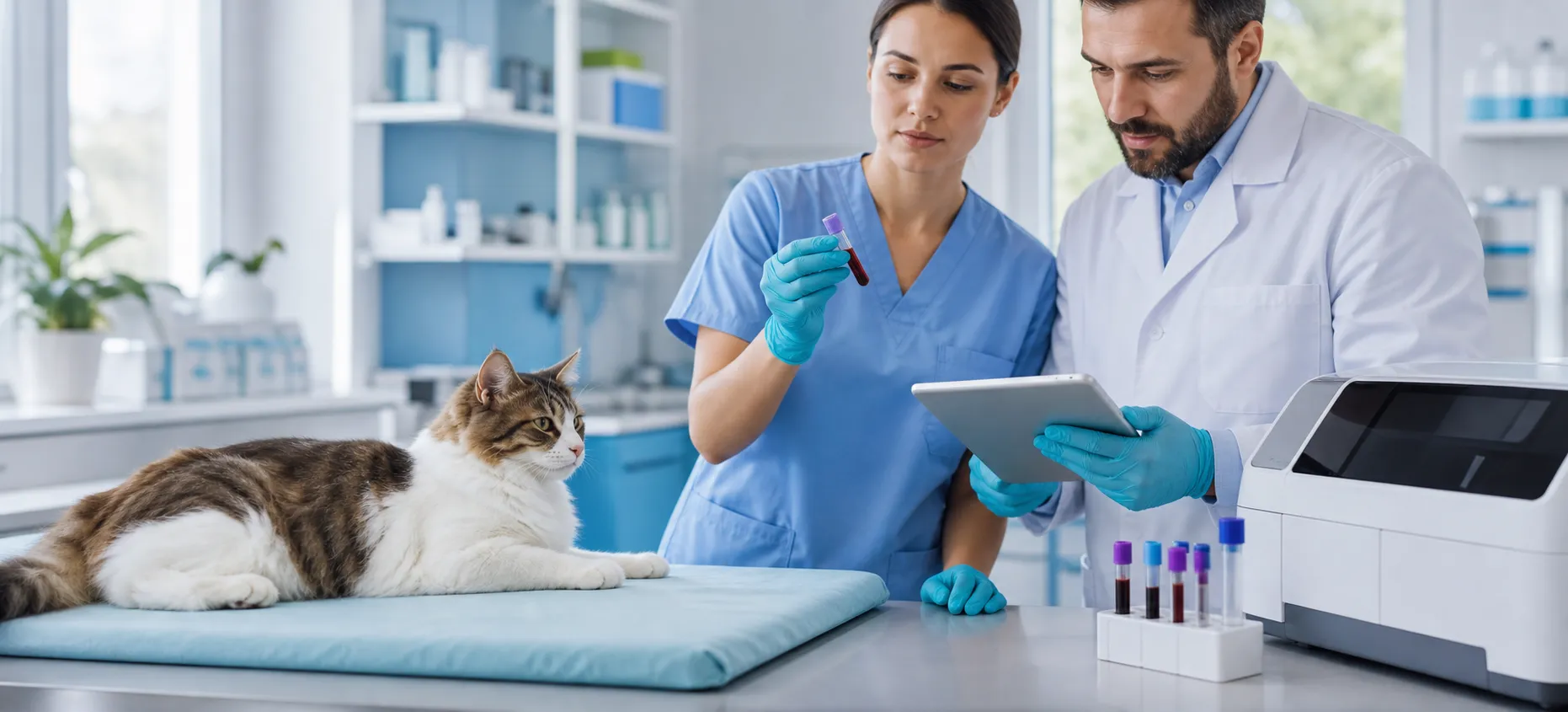
Laboratory testing is how we find feline disease before it becomes visible. Kidney disease, diabetes, and hyperthyroidism — the big three of senior cat medicine — can all be detected on routine screening long before a cat looks sick.
Our in-house laboratory returns results for sick patients within minutes, while our reference lab partnership covers specialized testing. We recommend baseline bloodwork for young cats and yearly to twice-yearly screening as cats mature.
Common feline tests
- Complete blood count and chemistry panels
- Thyroid (T4) screening
- Urinalysis and urine culture
- FeLV/FIV viral testing
- Fecal parasite screening
- Pre-anesthetic panels
What to expect
Blood draws take minutes with gentle, cat-savvy restraint. Sick-patient panels run in-house with results the same visit; wellness screens and specialized tests go to our reference lab with results in a few days, and we call you to walk through every value that matters.
FeLV & FIV testing
- In-house screening from a small blood sample
- Recommended for every new cat and kitten
- Retesting after potential exposure
- Guidance on next steps for positive results
Cat Lab Tests guides & handouts
Take-home guides from our resource library related to this service.
Frequently asked questions
My cat seems healthy. Why does she need blood tests?
Because cats hide disease until it's advanced. Kidney disease, hyperthyroidism, and diabetes — the big three of feline aging — are all detectable in lab work years before symptoms show, when treatment changes the disease's whole trajectory.
What do you actually check in a senior panel?
A complete blood count, organ chemistries (kidney and liver especially), electrolytes, thyroid hormone, and a urinalysis. Together they cover the conditions responsible for most feline illness after age ten.
What is an FeLV/FIV test and does my cat need one?
It's a quick in-house blood test for the two most important feline viruses. Every new cat should be tested before joining a household, after potential exposure (bite wounds from unknown cats), and when unexplained illness appears.
What are some possible cat health conditions that lab work can help detect?
The most common ones we see in kitties are kidney disease (especially in older kitties), hyperthyroidism, and urinary tract infections. Diabetes is also on the list.
What specific things are being looked at while using my cat's blood work? And what can it tell my veterinarian about my cat's health?
So, there are a bunch of different things to examine in lab work. Some values reflect organ function or organ abnormalities. Some are electrolytes, which can go in conjunction with organ function abnormalities. Thyroid level is critical, and our CBC, which is our blood cell count. The CBC checks for anemia and elevations in white cell counts, indicative of inflammation or infection, and urinalysis. So, we're looking for our concentration ability in the kidney and any signs of urinary tract infection.
Is blood work alone enough to ensure a proper diagnosis of a cat's illness?
Not always, but it gives us an excellent starting point. Blood work will provide us with a lot of information about organ function, diabetes, urinary tract infections, and hyperthyroidism. Sometimes we have to add on more lab work to the screening panels to make a further diagnosis. And sometimes, we'll recommend additional imaging like an abdominal ultrasound or x-rays to figure out exactly what's going on.
Why is early detection and diagnosis of cat illnesses using lab work so important?
Well, the earlier we detect it, the better chance we have at managing it appropriately. So, if we catch a problem early, we can start treatment early, we can change our diet early, and it reduces the risk that the kitty is not going to respond to treatment.
How is blood drawn from my cat?
Very similar to people. We use a needle, and we draw from whatever part in the kitty that is comfortable for them. Most frequently, that's going to be one of their limbs, either the front limb or back limb. If it's more comfortable for the kitty, we might draw from the neck, but it depends on what works for them.
Is the sample collection painful for my cat?
It's about the same as a person. So your furry friend will feel a little prick in the area. But other than that, they don't seem to mind too much.
How is the safety of my pet ensured when getting lab work done?
Kitties are very stressed-out creatures in general, so we always try to minimize stressors as much as possible. We like to keep them in a room by themselves where there aren't any dogs in the background or people that can scare them. We usually have at least two to three people on the case, one drawing the sample, one holding and petting the kitty, and maybe one distracting if we think that it's necessary.
Why might my kitten need lab work done?
A couple of reasons. Most commonly, we do kitten lab work in preparation for their spay and neuter. So we always want to check lab work before they go under anesthesia to make sure it's safe for them. Otherwise, we'd do lab work if there are any signs of illness—vomiting, weight loss, if their appetite is down, and also there's some viral testing we like to do on kittens as well.
Will follow-up lab work need to be done on my cat?
It depends on what the numbers are. Generally, we like to check the lab work once a year, depending on the kitty's age, to see where the numbers are going. And other than that, it depends on what the results are. If you notice kidney disease, we like to monitor those values periodically. If we start on any medication, we recheck the lab work afterward to monitor the response of the medication. If the cat is sick or there's any change in how they're doing at home, we do lab work. The last thing we consider is some additional tests to our screening lab work. Sometimes we add on other tests like urine culture or extended thyroid panels if it's not completely clear on the lab work what's wrong.
Ready to schedule?
Request an appointment at our Glendale clinic or call our team — we serve pets and their people across the surrounding communities.