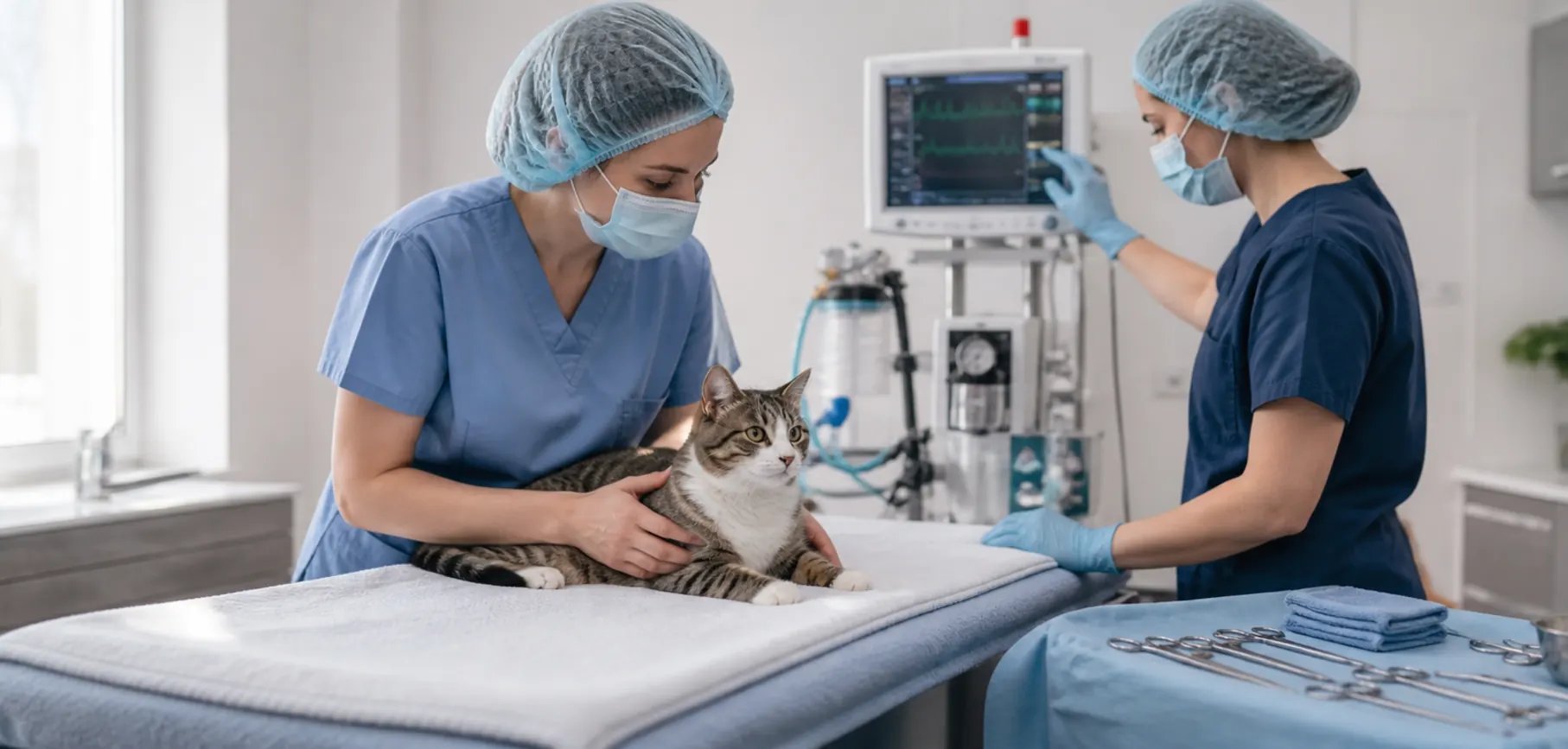
From spays and mass removals to bladder stone surgery and orthopedic procedures like fracture repair, our surgical service is built around the specific needs of feline patients — gentle handling, cat-calibrated anesthesia, and aggressive pain prevention. Both soft-tissue and orthopedic surgery are performed in-house.
Every surgery includes a pre-anesthetic exam and bloodwork, continuous monitoring by a dedicated team member, and a warmed recovery space away from dogs. You'll go home with clear written instructions and direct access to our team for any recovery questions.
Soft-tissue surgery
- Spay and neuter
- Mass and tumor removal
- Gastrointestinal foreign body removal
- Bladder stone removal (cystotomy)
- Abdominal exploratory surgery
- Pyometra surgery
- Splenectomy
- Wound and laceration repair
- Amputation
- Other soft-tissue procedures
What to expect
Surgery day: drop-off exam and pre-anesthetic bloodwork review, an individualized anesthetic protocol with IV support, continuous monitoring by a dedicated team member, and multi-modal pain control that starts before the incision. Your cat recovers in a warmed, dog-free space, and you go home with written aftercare and our direct line.
Orthopedic surgery
- Fracture repair
- Patellar luxation repair
- Femoral head ostectomy (FHO)
- Other orthopedic procedures
Additional surgical services
- Dental and oral surgery
- Eye surgery
- Ear surgery
- Emergency surgery
Surgical procedure guides
In-depth pages on the procedures we perform most — what each involves, when it's needed, recovery timelines, and expected outcomes.
Cat Surgery guides & handouts
Take-home guides from our resource library related to this service.
Frequently asked questions
How do I care for my cat's incision at home?
Keep it dry, keep it covered from licking (cone or recovery suit — licking is the number-one cause of complications), and look at it daily: mild redness early is normal, spreading redness, discharge, or gaps are a call-us-now. Most skin incisions heal in 10-14 days.
Will my cat be in pain after surgery?
Our protocols are built so the answer is no: pain medication before, during, and after the procedure, local nerve blocks where applicable, and take-home medication with clear dosing. A comfortable cat heals faster — pain control is medicine, not luxury.
When can my cat eat normally after surgery?
Usually a small meal the same evening once fully awake, back to normal feeding the next day unless we instruct otherwise. Appetite is also our favorite recovery signal — a cat who refuses food for more than a day after surgery should be checked.
When is cat surgery considered elective, non-elective, or emergency?
So cat surgeries are considered elective when they're non-emergency surgeries—things like spays, neuters, dental procedures, etc. Those kinds of things are elective procedures versus emergency procedures for wounds, significant injuries, and more life-saving things than those emergent surgeries.
What are the most common cat surgeries?
The most common cat surgeries are spays and neuters, dental procedures, and enterotomy or gastrotomy which are abdominal procedures for foreign bodies, and also wound management, fracture repairs, bladder stone removal—those are some of the main ones.
Will cats need lab work done before having surgery?
Yes, we require lab work before surgery, and that's mainly to help us understand how a patient is going to do with some of our anesthetic agents and know what their overall metabolic stability is going into the surgery.
What will the veterinarian be looking for in the pre-surgery lab work?
There are many different things that we get from the lab work. Some of the primary things that we look at are kidney and liver values. Those are the organs that metabolize or digest some of the anesthetic agents. And then, we're also looking at things like white blood cell count, red blood cell count, and platelets, which can also help us understand healing processes. And a few other indicators that allow us to understand how stable they are going into that procedure and how well we're going to anticipate they're going to be able to do are protein levels and electrolytes.
What do I need to know before my cat has surgery?
You should understand what the recovery time may be, what the actual procedure is intended to do, and how we will approach that. Is it going to be a small incision that we're going to be making versus a large incision? Are they going to need to have significant restrictions afterward? Some of those things are good to inquire about so that you know how to prepare yourself for going into it.
Who will be monitoring the cat while under anesthesia?
Here at Angelus Pet Hospital, we have registered veterinary technicians who are specifically licensed with a higher level of education and certification. And those technicians, in combination with a few other surgical technicians that we have specifically trained who are a part of our surgical team, are monitoring anesthesia while the doctors perform the procedure.
How long is recovery after a cat surgery?
Recovery time can be a bit variable depending on the specific type of procedure. The majority of soft tissue surgeries take about 10 days for the full recovery of a kitty to return to complete everyday activities. Some dental procedures require a day or two as the length of time they need to recover. And occasionally, some of the more extensive surgeries - wound repairs, abdominal surgeries - can be up to about two weeks or so.
What can be done to help your cat recover at home after surgery?
So the best thing to do to help a kitty recover after surgery is to pay attention to their discharge instructions when they get dismissed because a lot of those are explicitly catered to the cat—things that we think that they're going to need as far as pain management, sometimes antibiotics, and what to watch for that could indicate there is a problem. And a lot of cats are sent home with cones or collars to use afterward, which are essential for wound care, incision care, and a lot of these cats are going to go home with some activity restriction instructions—so paying close attention to those is important. And then one of the most important things is, if there's ever a concern at home, to reach out to us here at Angelus Pet Hospital because we want to make sure that every one of our patients has a good healing and recovery period.
What can I do at home to get my cat ready for surgery?
Have a conversation and a visit with your veterinarian in preparation for the surgery to know what we're getting into. But with the majority of our cat surgeries, we're going to want to have them fasted before the procedure, so no food in frequent proximity before the procedure. We want them fasted overnight, so no breakfast on the day of. Getting your cat into a carrier or being used to being in their carrier is essential so that they can travel safely to Angelus Pet Hospital.
How soon can my cat come home after surgery?
So on the day of their procedure, your veterinarian will be in touch with you about your cat's recovery, how the procedure went, and also set up the time that they will be going home. The staff will go over all of the discharge instructions with you. Typically, most of our patients will be going home from Angelus Pet Hospital late afternoon or early evening with their discharge instructions and will have been well recovered.
Ready to schedule?
Request an appointment at our Glendale clinic or call our team — we serve pets and their people across the surrounding communities.
Need help with the cost? Explore financing options