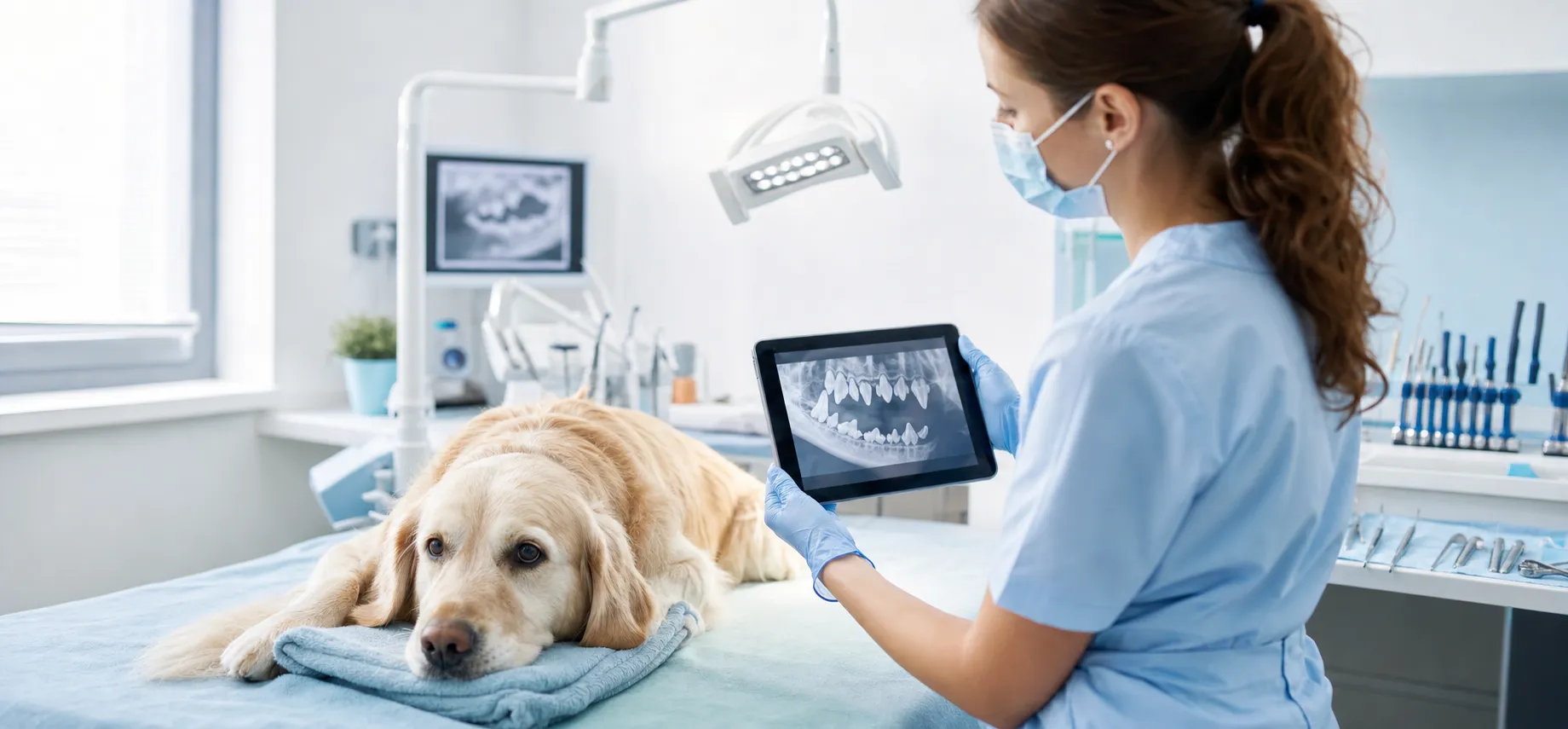
Bad breath isn't normal — it's the smell of infection. By age three, most dogs have dental disease, and the damage runs deeper than teeth: chronic oral infection seeds bacteria into the bloodstream and contributes to heart, liver, and kidney disease.
A proper dental procedure happens under anesthesia, where we can clean below the gumline, probe every tooth, and take full-mouth X-rays — the only way to find the painful problems hiding beneath. Diseased teeth are extracted with local nerve blocks so your dog wakes up comfortable and eats better than before.
Dental services
- Oral assessment at every wellness exam
- Ultrasonic scaling and polishing under anesthesia
- Full-mouth digital dental X-rays
- Surgical extractions with nerve blocks
- Post-procedure pain management
- Realistic home care plans — brushing, chews, and diets
What to expect
A canine dental (COHAT) runs as a day procedure under anesthesia: full-mouth X-rays, probing of every tooth, ultrasonic scaling above and below the gumline, polishing, and extractions with local nerve blocks where teeth can't be saved. You get photos, findings, and a home-care plan calibrated to what your dog will actually allow.
Dog Dental Care guides & handouts
Take-home guides from our resource library related to this service.
From our blog
Frequently asked questions
How bad is dental disease, really, if my dog is still eating?
Dogs eat through severe dental pain — appetite is the last thing to go. Meanwhile infection erodes bone and seeds bacteria to the heart, liver, and kidneys. After extractions of diseased teeth, owners routinely tell us their dog acts years younger; that's what untreated pain was costing.
Why does a proper dental require anesthesia?
Because the disease lives below the gumline: X-rays, probing, and subgingival cleaning are impossible in an awake dog. 'Anesthesia-free cleaning' polishes the visible crown and misses the pathology — cosmetic reassurance while problems progress.
How can I keep my dog's teeth healthy between cleanings?
Daily brushing with pet toothpaste is the gold standard — even three times weekly measurably helps. Add VOHC-accepted chews or dental diets, and follow the five-minute rule: a chew gone in under five minutes isn't cleaning anything.
What are some signs and symptoms of dental disease in dogs?
The most common symptom or sign of dental disease in dogs is bad breath. So really, if your dog has chronically bad breath, that's because there's a lot of nasty bacteria underneath the gum line, creating some really nasty smells. And so that's the most common. There are more severe signs, but not until they're really severe, and that would be if they're drooling or dropping food. That's when the mouth is so bad that they can't even eat.
What are some of the common dental diseases in dogs?
We have gingivitis, which is inflammation of the gums along the border between the tooth and the gum. So you would see the redness of the gum. Periodontal disease is a more severe disease when the disease goes underneath the gum line and up the inside of the tooth. That's periodontal disease. We can also have broken teeth. Dogs get tumors in their mouth. Certain tumors grow due to inflammation in certain breeds, or they can get oral cancers. So really, when we talk about dental disease and oral health, we're talking about all the above.
Why is early detection and diagnosis of dental disease so important?
By keeping the mouth really clean, just like you or me, if we have regular dental care and have our teeth professionally cleaned hopefully at least twice a year and we are really good about brushing and flossing at home, we can keep our teeth clean and our mouths healthy. If we wait three years and then start doing that, we're going to have many more issues. It's the same thing with dogs and cats that if we can keep their mouths healthy, keep them healthy beforehand, then we're going to get to keep those teeth a lot longer, and we'll have a lot less pain in the mouth as well.
How often should my dog's teeth be checked?
At a minimum, once a year. So in dogs above 10 years, we recommend twice a year because we start to see things accelerate more at that stage, and we begin to see a lot more dental disease. And we don't want to wait and hold off. I know some people get fearful of dentals because they require anesthesia, and people are afraid of anesthesia. And I always tell people that I know for sure that the dental disease will progress. There's always some risk with anesthesia. But honestly, we never have any issues here because we're so diligent with our anesthetic protocols. And so there is nothing to worry about. There are things to worry about, though, with letting dental disease progress, which are pain and illness, and that's not a good situation.
What is a professional dental cleaning like for my dog?
Your dog would come to the veterinary clinic or hospital first. We would examine them before the day of the procedure, and we would draw some blood to make sure that their kidney and liver and everything's in good shape. We will check their heart and do a thorough physical exam on them before we do any anesthesia. Then the day they come in here, we're going to go ahead and give them just a little pre-anesthetic for anxiety and to help with soothing the anesthetic procedure. We're going to place an IV catheter. That's so they can have fluids, and that's a way of supporting them during the anesthetic process. At some point, they're going to be anesthetized, and they're going to be intubated, being that they're going to have a tracheal tube down into their throat. So we help them breathe. And that's how we administer the gas anesthetic as well. Then the dental cleaning is going to occur, and the doctor will be right there with the technician who's doing the cleaning. We're going to take dental X-rays because half the tooth is underneath the gum line. So if we don't take dental X-rays, we don't know what's going on. We're going to assess the X-rays. We're going to check the pockets of the teeth, the space between, how much space is underneath the gum that's being exposed, or a cause for any pain. That could be a place where there's disease, periodontal disease. And then we're going to decide whether or not there's going to need to be any extractions, which hopefully that's not the case. Before we do anything like that in the dental surgery, we're going to call you and let you know what we found and get your permission to go ahead and proceed, which you generally are going to do. We're going to wake your pet, then after the procedure, provide pain medication, which can include an intraoral (local) block. It's going to include IV meds and probably some oral medication to go home. They're going to stay with us until they're completely recovered from the anesthesia. But when we send them home, and they are still going to be a little bit sleepy. So you can anticipate that. But certainly, we take calls for a couple of hours after this. So if anything is going on, you're always welcome to call us.
Are there any tips for making brushing a dog's teeth easier?
We will be happy to show you when you're here at the hospital, but we also have a video online to show you. Dog toothpaste and dog toothbrushes explicitly made for them will make it easier for you to do that. And we do have different sizes; we don't have the same size for a Chihuahua as our German Shepherd. So there are different sizes and even different flavors of toothpaste.
Can I use human toothpaste on my dog?
No, we don't recommend that you use human toothpaste on your dog because it's not meant to be swallowed, and the dogs will swallow their toothpaste because they're not going to be spitting. So we want you to use dog toothpaste.
Can dogs get cavities?
Dogs can get cavities, although they're pretty rare. We see a lot more periodontal disease and gingival disease, and broken teeth due to chewing on things. But they can get cavities.
Ready to schedule?
Request an appointment at our Glendale clinic or call our team — we serve pets and their people across the surrounding communities.
Need help with the cost? Explore financing options