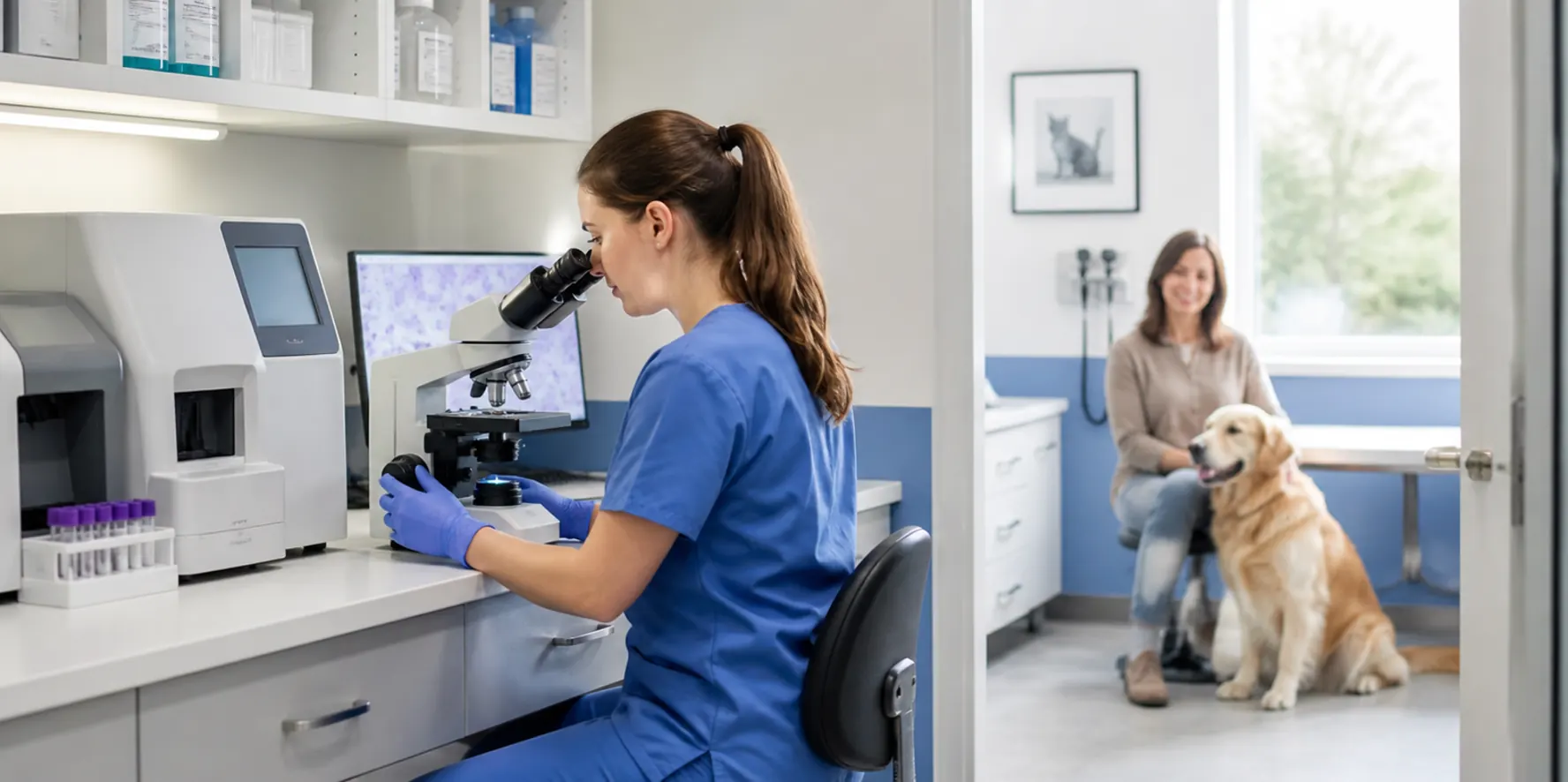
Lab work is our window into what the exam can't reveal. For sick dogs, our in-house laboratory returns blood counts, organ chemistries, and urinalysis in minutes, guiding treatment decisions the same visit. For healthy dogs, yearly screening establishes baselines and flags kidney, liver, and endocrine changes long before symptoms appear.
Specialized tests — thyroid panels, tick disease screening, cultures, hormone testing — run through our reference laboratory with results typically back within days.
Testing capabilities
- Complete blood count and chemistry panels
- Urinalysis and urine culture
- Heartworm and tick-borne disease screening
- Thyroid and endocrine testing
- Fecal parasite exams
- Pre-anesthetic panels
What to expect
Blood draws take a few minutes; sick-patient panels run in-house with same-visit results, while wellness screens and specialty tests return from our reference lab within days. Every abnormal value gets explained in plain language, with a plan attached.
Dog Lab Tests guides & handouts
Take-home guides from our resource library related to this service.
Frequently asked questions
What does annual bloodwork check in a healthy dog?
A complete blood count, organ chemistries (kidney, liver, pancreas), electrolytes, and often thyroid and urinalysis. The value compounds: year-over-year trends catch disease while a single 'normal' snapshot still looks fine.
Why does my dog need bloodwork before dental work or surgery?
Anesthetic drugs are processed by the liver and kidneys — pre-anesthetic testing confirms those organs are up to the job, or lets us adjust the protocol before there's a problem. It's the cheapest anesthesia safety measure that exists.
The vet mentioned a tick-borne disease screen. What is that?
A quick test (usually bundled with the heartworm test) for exposure to the common tick-transmitted infections. Positive exposure doesn't always mean illness, but it tells us to look closer — these diseases are very treatable when caught early.
When Will A Veterinarian Recommend Dog Blood Tests?
The following situations can result in dog blood work being ordered: **On the first veterinary visit:** We recommend puppies have blood test to rule out congenital diseases, for baseline information and for pre anesthetic testing prior to spay or neuter **During semi-annual wellness exams:** This is recommended if your veterinarian suggests it as part of a thorough physical examination because dog blood work, along with other bodily fluids like urine, can help identify conditions the examination portion of a physical cannot **If a dog seems not quite right:** Canine blood tests are suitable for a dog that is not displaying any overt signs of illness, disease or injury, but is acting abnormal **Pre-surgical tests:** Dog blood work is used to determine the efficiency of the liver and kidneys, which helps a veterinarian select the safest dose of anesthesia. Tests can also help determine the surgical risk level in infirm, elderly or injured patients **Prior to starting a new medication:** Particularly for a new medication that may be metabolized by the liver or kidney **During senior wellness exams:** Dog blood tests are usually recommended for mature, senior and geriatric dogs as part of their periodic wellness exams. These are extremely beneficial, as we often see senior dogs return to a more youthful state of being when blood tests identify an issue that can be easily treated Although our in-house dog laboratory can process some types of dog blood work, most lab work is sent to an outside laboratory for analysis. Some of the most common lab work for dogs we perform are: **Urinalysis:** We evaluate your dog's urine to reveal hydration status, infections, kidney or bladder disease, diabetes and other health conditions **Fecal Exam:** We recommend checking your dog's stool sample annually. It is sent to a lab and analyzed for intestinal parasites, such as worms or protozoa. It is also checked for color, consistency, as well as the presence of blood or mucus. **Complete Blood Count (CBC):** We analyze your dog's blood to assess features of the blood, including red and white cell count, immunity status, and the measure of hemoglobin, which is the actual substance in red blood cells that carries oxygen **Blood Clotting Times:** We test your dog's blood for bleeding disorders **Blood Chemistries:** We identify the status of your dog's internal organs, and also gauge their health before anesthetizing for surgery **Cytology:** We collect samples of sebum and cellular debris on the skin and in the ears to determine if infection is present. In addition, we may perform needle or core biopsy of lumps or masses on your dog's body to look for cancer cells. We recommend discussing lab tests for dogs with your veterinarian, in order to make an informed decision as to whether or not your canine friend can benefit from dog blood work.
How Our Dog Laboratory Processes Blood Work
In addition to having veterinary staff on duty to handle pet health emergencies, Angelus Pet Hospital also has its own in-house laboratory. Although this means we can process all kinds of lab work for dogs quickly and reliably, it is in emergency situations, when time is of the essence, our in-house dog laboratory is most helpful. After all, if we can draw, process and analyze dog blood work on the premises, then we can have the results we need immediately. This increases the chances that we can determine what the issue is, and then implement a successful medical intervention based on the results. In this way, our dog laboratory allows us to be a proactive and timely partner in your dog's health and care.
Understanding Canine Blood Tests
Understanding dog blood tests is second nature to us. However, we understand that the same might not be said for you. This is why we always fully explain the results of canine blood tests with a patient's human caretakers. After all, arresting and treating whatever a blood test indicates takes an informed and concerted team effort. If we are ordering dog blood work, it will most likely be in the form of a Complete Blood Count, or else a Blood Chemistry (serum) test. The Complete Blood Count, or CBC, shows a veterinarian your dog's hydration status, anemia, infection, blood clotting ability and immune system response. A CBC is essential for dogs that have symptoms like fever, vomiting, diarrhea, weakness, pale gums or loss of appetite. If your dog needs surgery, a CBC can also detect bleeding disorders or other unseen abnormalities. Specifically, a Complete Blood Count provides detailed information including: **Hematocrit (HCT):** This test measures the percentage of red blood cells to detect anemia and hydration **Hemoglobin and mean corpuscular hemoglobin concentration (Hb and MCHC):** These are the oxygen-carrying pigments of red blood cells **White blood cell count (WBC):** This test measures the body's immune cells. Increases or decreases in the WBC indicate certain diseases or infections **Granulocytes and lymphocytes/monocytes (GRANS and L/M):** These are specific types of white blood cells **Eosinophils (EOS):** These are a specific type of white blood cells that may indicate allergic or parasitic conditions **Platelet count (PLT):** This test measures cells that form blood clots **Reticulocytes (RETICS):** These are immature red blood cells. High levels indicate regenerative anemia **Fibrinogen (FIBR):** This test provides important information about blood clotting. Blood Chemistries, or blood serum tests, evaluate a dog's organ function, electrolyte status, hormone levels and more. These tests are important to evaluating the health of older dogs, dogs with signs of vomiting, diarrhea or toxin exposure, as well as dogs receiving long-term medications and general health before anesthesia. **Albumin (ALB):** This is a serum protein that helps evaluate hydration, hemorrhage and intestinal, liver and kidney disease **Alkaline phosphatase (ALKP):** Elevations in this test may indicate liver damage, Cushing's disease or active bone growth in a young dog **Alanine aminotransferase (ALT):** This test may determine active liver damage, but does not indicate the cause **Amylase (AMYL):** Elevations in this test indicate pancreatitis or kidney disease **Aspartate aminotransferase (AST):** Increases in this test may indicate liver, heart or skeletal muscle damage **Blood urea nitrogen (BUN):** This test determines kidney function. An increased level is called azotemia and can be caused by kidney, liver and heart disease as well as urethral obstruction, shock or dehydration **Calcium (Ca):** Changes in the normal level of this test can indicate a variety of diseases. Tumors, hyperparathyroidism, kidney disease, and low albumin are just a few of the conditions that alter serum calcium **Cholesterol (CHOL):** This test is used to supplement diagnosis of hypothyroidism, liver disease, Cushing's disease and diabetes mellitus **Chloride (Cl):** Chloride is an electrolyte that is typically lost with symptoms like vomiting or illnesses such as Addison's disease. Elevations often indicate dehydration **Cortisol (CORT):** Cortisol is a hormone that is measured in tests for Cushing's disease (the low-dose dexamethasone suppression test) and Addison's disease (ACTH stimulation test) **Creatinine (CREA):** This test reveals kidney function and helps distinguish between kidney and non-kidney causes of elevated BUN **Gamma-glutamyl Transferase (GGT):** This is an enzyme that indicates liver disease or corticosteroid excess **Globulin (GLOB):** This is a blood protein that often increases with chronic inflammation and certain disease states **Glucose (GLU):** Glucose is blood sugar. Elevated levels may indicate diabetes mellitus. Low levels can cause collapse, seizures or coma **Potassium (K):** This is an electrolyte typically lost with symptoms such as vomiting, diarrhea or excessive urination. Increased levels may indicate kidney failure, Addison's disease, dehydration or urethral obstruction. High levels can lead to cardiac arrest **Lipase (LIP):** Lipase is an enzyme that may indicate pancreatitis **Sodium (Na):** Sodium is an electrolyte often lost with signs of vomiting, diarrhea, kidney disease and Addison's disease. This test helps indicate hydration status **Phosphorus (PHOS):** Elevations in this test are often associated with kidney disease, hyperthyroidism and bleeding disorders **Total bilirubin (TBIL):** Elevations in this test may indicate liver or hemolytic disease. This test helps identify bile duct problems and certain types of anemia **Total protein:** This test indicates hydration status and provides additional information about the liver, kidneys and infectious diseases **Thyroxine (T4):** Thyroxine is a thyroid hormone. Decreased levels often signal hypothyroidism in dogs In order to determine which dog blood tests can best benefit your canine friend, we recommend scheduling a veterinary appointment.
Ready to schedule?
Request an appointment at our Glendale clinic or call our team — we serve pets and their people across the surrounding communities.