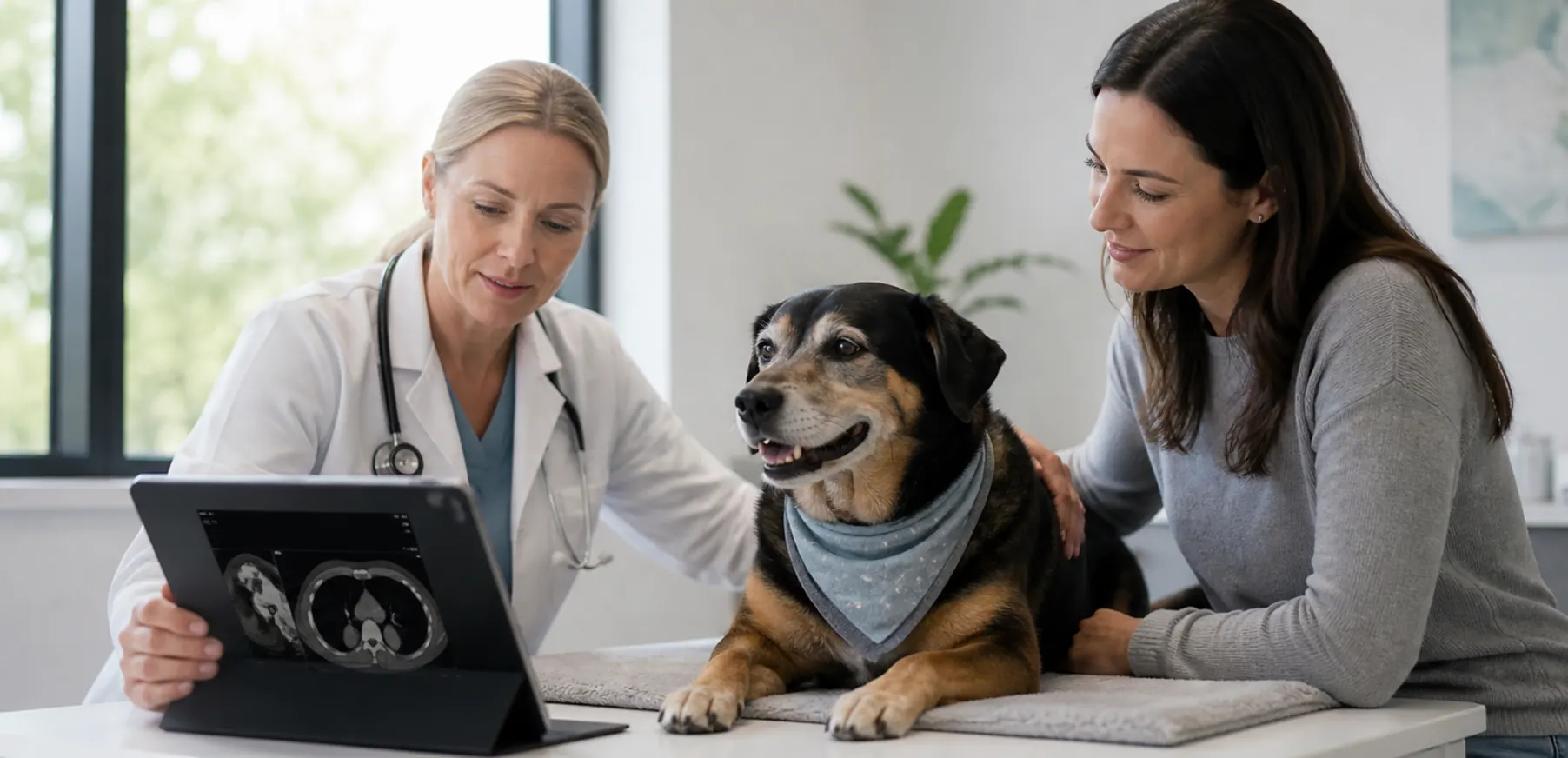
Half of dogs over age ten will develop cancer — but a cancer diagnosis is not an automatic goodbye. Many canine cancers are curable with surgery when found early, and many others can be managed for meaningful, comfortable time.
Every new lump deserves testing rather than watching: a quick needle sample often tells us in minutes whether a mass is fatty and harmless or something that needs action. When cancer is confirmed, we stage it, explain every reasonable path — surgery, oncology referral, or comfort-focused care — and support whichever you choose.
Oncology support
- Same-visit lump testing (fine needle aspirate)
- Biopsy and histopathology
- Staging with imaging and lab work
- Tumor removal surgery
- Oncologist referral for chemotherapy or radiation
- Palliative and hospice care
What to expect
First visit: examine and sample the mass (usually a same-visit needle aspirate) or work up the symptoms. If cancer is confirmed, staging tests map its extent, and then we lay out every reasonable option — surgery here, oncology referral, or palliative care — with honest numbers on cost, burden, and expected benefit for each.
Dog Cancer Care guides & handouts
Take-home guides from our resource library related to this service.
Frequently asked questions
I found a lump on my dog. Should I just watch it?
Test it — a needle aspirate takes minutes and often distinguishes a harmless fatty lipoma from something needing action. 'Watch and see' with an unidentified lump only gives a bad actor time to grow. Small masses are easier and cheaper to remove.
How is chemotherapy different for dogs than for people?
The dosing philosophy is different: veterinary protocols prioritize quality of life, so most dogs sail through with mild or no side effects — significant nausea or illness affects a small minority, and we adjust immediately when it appears.
What does palliative care for a dog with cancer look like?
Aggressive comfort: pain control, appetite support, anti-nausea medication, and scheduled quality-of-life check-ins — with our team a phone call away. Choosing comfort over treatment is a legitimate, loving path, and dogs on good palliative care often enjoy real, wagging months.
Is cancer in dogs common?
Yes. Cancer in dogs is relatively common. We tend to see a fair amount in dogs as they age and sometimes in younger dogs. But for the most part, we see cancer in dogs after about the age of nine.
What are the common types of cancer in dogs?
Some of the more common cancers we see are skin cancers, so you might see lumps and bumps on your dog, or mast cell disease. There are other types of skin cancers also, or just underneath the skin cancers. There are brain tumors. Unfortunately, hemangiosarcoma is a fairly common cancer we see in some larger breed dogs. Also, lymphoma is widespread. That's a cancer of the lymph system and bladder cancer. That's as many as I can think of right now. But pretty much every type of cancer that humans can get, we see those in dogs also.
What are some of the signs and symptoms of dog cancer?
People often have no idea that they have a tumor growing inside them, and dogs are no different. Many of them don't have any symptoms, so veterinarians must do annual exams on your dog. Doctors pick up things quite often. When we palpate your dog, or when we feel your dog's abdomen as part of the exam, we'll often find a large spleen or a tumor. We sometimes find things during rectal exams as well. We’ll see lumps and bumps on the body, many of them are benign, but some are not. And so the only way to know if those tumors are not benign is to put a needle in them and do a needle aspirate or a biopsy of them. We palpate the lymph nodes when we do exams. We feel the lymph nodes for signs of enlargement. You have lymph nodes all over your body. Some are easy to palpate, meaning we can feel them on the exam. During oral exams, we find cancers in the mouth and the extremities, or sometimes in the eye. As the dog owner, you want to look for weight loss and breathing difficulty, but unfortunately, these symptoms are when cancers are far gone. Otherwise, if you see lumps or bumps or something else you haven't seen on your dog before, bring them in. Annual exams are essential, but you should also be looking for anything out of the ordinary.
Why is early detection of dog cancer so important?
If we find cancers early, we can treat them better, just as with people. We can diagnose them quickly and get the treatment started quicker, and hopefully, that will mean that the prognosis is much better.
How would a veterinarian diagnose cancer in your dog?
Diagnosing cancer in your dog involves a combination of you telling us the history, perhaps finding a bump at home, or us finding things during an exam. As dogs age, we may want to take chest films as a survey to have a look, just like we do for us sometimes. Sometimes we'll do pre-anesthetic things, and we'll see something in the lab work. Blood work generally does not diagnose cancer, but it may give us a clue if something's abnormal. If the white blood cell count is very high or the red blood cell count is very low, these can be signs that we want to look into, and then we may find cancer. X-rays and abdominal ultrasounds are also vital, and we also sometimes do ultrasounds of the chest. We perform a lot of biopsies of lumps, needle biopsies, and punch biopsies of lumps that we find on your dog's body to make sure that they're benign. And if they're not, we're going to want to take them off.
What treatment options are available for dogs with cancer?
So surgical is certainly an option. Chemotherapies. I tell people, everything that we have available for humans, we almost always have available for dogs. It just depends on the prognosis and how much you're willing to spend or can spend, as every case is different. I've had dogs that are really in rough shape, and I'm not going to recommend they go any further with treatment because I don't think it's going to do the dog any favors. But we do have many excellent treatments that can prolong a high quality of life for your dog. We can completely cure mast cell cancers if we get to them early. So it's vital to start collecting information and help us be your partner as you go through that with your dog.
What are some possible side effects caused by cancer treatment?
Just as in humans, radiation therapies and chemotherapies can cause side effects in dogs, and a couple of my dogs have had both radiation and chemotherapies. One of them had no symptoms, the other had a lot of side effects, so it depends on the dog. Dogs tend to tolerate chemo better than humans do, and we do have a lot of medications for nausea and things now that are great drugs. But still, some dogs can have side effects. So it's just dependent on the pet.
What happens after a dog is diagnosed with cancer?
After a few visits, we work to get a specific diagnosis to better understand how we're going to treat it and its prognosis. Here at Angelus Pet Hospital, we do a fair amount of surgeries to remove cancers. We also work closely with our local specialists, who are oncologists and radiation oncologists. For clients who choose to go those routes, we're going to partner with the specialists and pet owners to ensure we have all the crucial information. We then use this information to decide what's best for your dog.
Have there been advancements in the treatment of dog cancer?
Yes, for sure, there have been. We now have even some injectable chemotherapeutic agents that we did not have before, specifically treating mast cell disease. And we learn more every day. I would say that maybe we're not quite as advanced as human medicine in treating cancers, but we're pretty advanced in our information that we have and our abilities to provide longer, higher-quality lives for dogs.
What is the cure rate of dogs with cancer?
I don't know the cure rate specifically, honestly. There are some cancers that we can cure as soon as we surgically remove them. We can put some dogs in remission, and then we find the remission just keeps going on and on, like lymphomas. And there are some dogs that we can buy them a quality one to two years. And, for many owners, it's worthwhile to go ahead and treat that. I don't know that I have a number for you for the cure rate, but there are many dogs that we indeed can help have a high quality of life for a more extended time. And that's what we're here for.
Is a dog cancer diagnosis a death sentence?
Absolutely not. We see cancers and cure them - or at least treat them and put them in remission - all the time. And we're here to help guide the clients, give them the best information, and work with them to get the best prognosis for their dog.
Ready to schedule?
Request an appointment at our Glendale clinic or call our team — we serve pets and their people across the surrounding communities.